What Is Health Optimization? Your 2026 Guide
What Is Health Optimization? Your 2026 Guide
Health optimization is defined as the active, data-driven practice of improving your physiological function, vitality, and longevity beyond the absence of disease. Where traditional medicine asks “Are you sick?”, health optimization asks “How well can you actually function?” This field, increasingly formalized as healthspan medicine, uses personalized biomarkers, wearable technology, functional assessments, and targeted interventions to push your biology toward its best possible state. Grownupmeds operates precisely in this space, connecting adults with physician-supervised protocols that go far beyond a standard annual physical.

What is health optimization and how does it differ from preventive care?
Health optimization and preventive care share a common foundation but diverge sharply in ambition and method. Preventive care focuses on avoiding disease. Health optimization focuses on measurably improving how your body and mind perform right now, using every available data point to get there.
Standard preventive medicine relies on population-level guidelines: get a flu shot, maintain a healthy weight, avoid tobacco. These are valuable, but they treat you as an average. Health optimization treats you as an individual. Healthspan medicine builds personalized plans from patient-reported data, physiological biomarkers, functional assessments, and wearables to detect early health perturbations before symptoms appear. That is a fundamentally different operating model.
Here is where the two approaches diverge most clearly:
- Preventive care responds to risk factors identified in population studies.
- Health optimization responds to your specific biomarker trends, functional test results, and personal goals.
- Preventive care typically involves annual check-ins and reactive adjustments.
- Health optimization uses continuous feedback loops, ongoing monitoring, and iterative interventions.
- Preventive care measures disease absence. Health optimization measures performance improvement.
| Factor | Preventive care | Health optimization |
|---|---|---|
| Goal | Avoid disease | Improve function and longevity |
| Data inputs | Standard labs, BMI, blood pressure | Biomarkers, wearables, functional tests |
| Frequency | Annual or episodic | Continuous monitoring |
| Personalization | Population-based guidelines | Individual-specific protocols |
| Outcome measure | Disease incidence | Vitality, resilience, performance |
Pro Tip: If your doctor only reviews your labs once a year and calls you if something is “out of range,” you are in a preventive care model. Health optimization requires tracking trends over time, not just snapshots.
What are the foundational pillars of health optimization?
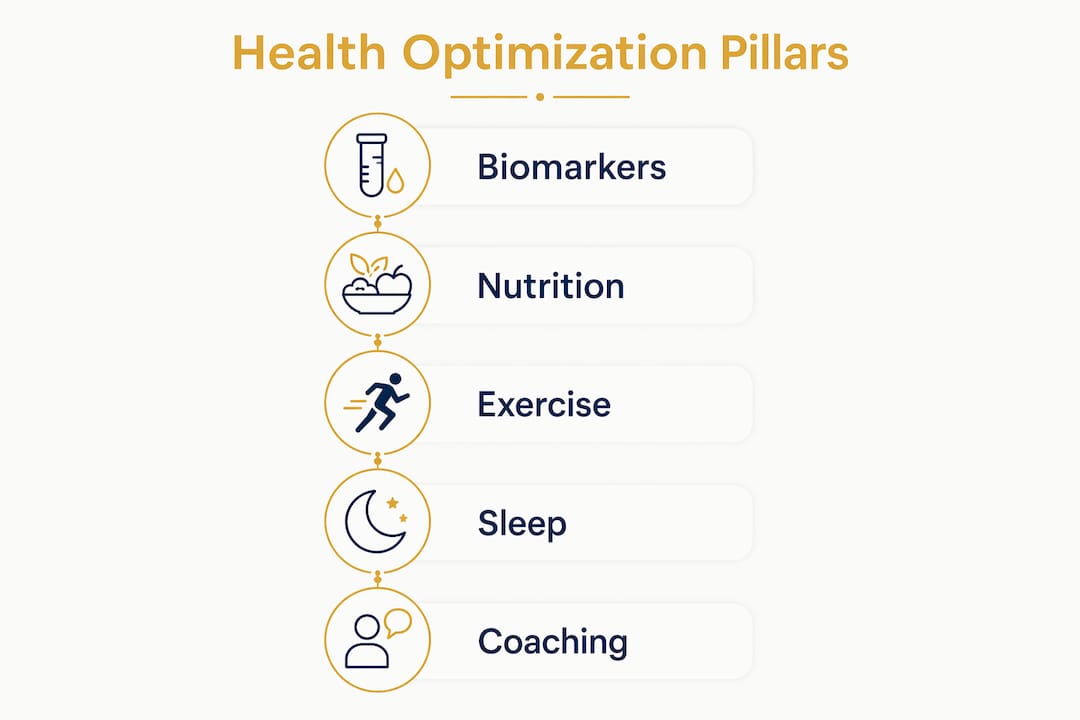
Health optimization extends healthspan by improving sleep quality, strength, metabolism, cardiovascular function, hormonal balance, and cognitive clarity. These outcomes do not happen by accident. They emerge from four well-established pillars, each supported by quantitative tracking and, where appropriate, targeted therapies.
The four core pillars are:
- Nutrition: Precision nutrition goes beyond calorie counting. It involves tracking macronutrient ratios, micronutrient levels, inflammatory markers, and gut health indicators to fuel your specific metabolic needs.
- Exercise: Structured physical training targeting cardiovascular capacity, muscular strength, and mobility. Coordinated lifestyle interventions including exercise counseling can reduce coronary heart disease risk by over 80%, a figure that underscores how much lifestyle drives outcomes.
- Sleep: Restorative sleep is not optional infrastructure. It is where cellular repair, hormonal regulation, and memory consolidation occur. Tracking sleep architecture through wearables like Oura Ring or WHOOP reveals quality, not just duration.
- Social connection: Chronic isolation elevates cortisol, suppresses immune function, and accelerates biological aging. Social health is a quantifiable variable in any serious optimization program.
Beyond these pillars, a growing set of clinical therapies now plays a meaningful role in adult health optimization:
- Peptide therapy: Specific peptides like BPC-157 and CJC-1295 support tissue repair, growth hormone secretion, and metabolic function under physician supervision.
- NAD+ therapy: Nicotinamide adenine dinucleotide supports mitochondrial energy production and DNA repair. Levels decline with age, making supplementation a target for longevity-focused protocols.
- Hormone optimization: Testosterone, estrogen, and thyroid hormones directly regulate energy, body composition, and cognition. Supervised hormone protocols prevent the adverse effects that arise from unsupervised use.
- AI-assisted monitoring: Platforms now use artificial intelligence to analyze biomarker trends and flag deviations before they become clinical problems.
Healthspan medicine teams include medical professionals and healthspan coaches who use biomarker updates and AI tools to support behavior change. This is not a solo endeavor. It is a coordinated system.
Pro Tip: Do not start with therapies. Start with the four pillars. Peptide therapy and NAD+ work best when layered onto a foundation of solid sleep, nutrition, and movement, not as substitutes for them.
How to design a personalized health optimization plan
A well-designed health optimization plan follows a clear sequence: assess, define, measure, intervene, and iterate. Skipping steps, especially the first two, is the most common reason people spend money on supplements and therapies without seeing results.
-
Establish your baseline. A comprehensive health assessment uses biomarkers, functional tests, and patient history to map your current physiological state. This includes metabolic panels, hormonal profiles, inflammatory markers, and body composition data. You cannot optimize what you have not measured.
-
Define your goals with precision. Vague goals produce vague results. “I want more energy” is not a goal. “I want to reduce daytime fatigue from a 6/10 to a 2/10 within 90 days” is a goal. Applying the scientific method to your own health means setting clear optimization targets and measuring them directly.
-
Measure what actually matters. This is where most people go wrong. If your goal is to feel rested, measure restfulness, not just hours slept. Proxy metric substitution produces misleading results because you optimize the wrong variable. Track the outcome you care about, not a convenient stand-in.
-
Introduce one change at a time. Testing multiple interventions simultaneously makes it impossible to know what worked. Change one variable, track it for four to six weeks, then evaluate. This is how you build a personal evidence base rather than guessing.
-
Use expert guidance and continuous feedback. Telehealth platforms with ongoing biomarker monitoring outperform infrequent annual check-ins by a significant margin. Continuous feedback loops allow you to adapt protocols as your biology responds. Grownupmeds structures its programs around exactly this model.
Pro Tip: Use a simple tracking tool like a spreadsheet or an app like Cronometer to log your key metrics weekly. The act of tracking alone improves adherence and reveals patterns that would otherwise stay invisible.
What are the biggest pitfalls in health optimization?
The most dangerous trap in health optimization is the belief that more is always better. More supplements, more protocols, more data, more interventions. This mindset produces stress, confusion, and diminishing returns rather than better health.
The trap of endless optimization warns against constantly seeking more inputs while forgetting to listen to your body’s signals. Dr. Tieraona Low Dog, a recognized integrative medicine physician, has documented how over-optimization creates physiological stress that directly undermines the outcomes you are chasing. Rest, recovery, and subtraction are not signs of failure. They are active components of any serious protocol.
“Sometimes the most powerful optimization move is to do less, not more.”
Other common pitfalls to avoid:
- Chasing proxy metrics. Optimizing sleep score on your Oura Ring instead of how you actually feel is a proxy error. The score is a tool, not the goal.
- Following one-size-fits-all advice. Generic protocols from social media influencers ignore your individual biomarker profile, genetics, and lifestyle context.
- Ignoring systems biology. Your cardiovascular, hormonal, gut, immune, and musculoskeletal systems are interconnected. A systems biology approach treats these as a coordinated network, not isolated problems.
- Skipping physician oversight for advanced therapies. Using GLP-1 agonists, peptides, or hormone therapy without medical supervision can cause muscle loss, hormonal disruption, and metabolic imbalance.
Pro Tip: Every quarter, audit your current protocols and ask: “What can I remove?” Simplifying your stack often produces better results than adding to it.
What measurable benefits can you expect from health optimization?
The benefits of consistent health optimization are not abstract. They are measurable, trackable, and well-documented across metabolic, cardiovascular, cognitive, and hormonal domains.
Primary prevention strategies that combine exercise, nutrition, and clinical support can reduce cardiovascular disease risk by over 80%. That single figure represents years of quality life preserved. The goal of health optimization is not just a longer lifespan but a longer healthspan, the period of life spent in full physical and cognitive function.
| Benefit area | What optimization targets | Expected outcome |
|---|---|---|
| Metabolic health | Insulin sensitivity, body composition | Reduced diabetes risk, stable energy |
| Cardiovascular function | VO2 max, blood pressure, lipid profile | Lower cardiac event risk |
| Hormonal balance | Testosterone, estrogen, thyroid | Improved mood, libido, body composition |
| Cognitive clarity | Inflammation, sleep quality, NAD+ levels | Sharper focus, better memory |
| Longevity markers | Biological age, telomere health | Extended healthspan |
Monitoring progress through regular biomarker panels and body composition tracking is what separates sustained results from temporary improvements. Without measurement, you are guessing.
Key takeaways
Health optimization is the practice of using personalized data, targeted interventions, and continuous monitoring to measurably improve physical function, metabolic health, and longevity, not just avoid disease.
| Point | Details |
|---|---|
| Definition matters | Health optimization targets measurable performance gains, not just disease prevention. |
| Four core pillars | Nutrition, exercise, sleep, and social connection form the non-negotiable foundation. |
| Measure direct outcomes | Track the goal itself, not a proxy metric, to avoid misleading results. |
| Avoid over-optimization | Subtraction and rest are active tools, not signs of failure. |
| Expert oversight is critical | Physician-supervised protocols prevent adverse effects from advanced therapies. |
Why I think most people approach health optimization backwards
I have spent years reviewing how adults engage with health optimization, and the pattern is consistent. People start with the exciting stuff: peptide stacks, NAD+ infusions, continuous glucose monitors. They skip the baseline assessment. They skip defining what they actually want. Then they wonder why their expensive protocol is not moving the needle.
The science is clear on this. Tailoring lifestyle changes with comprehensive data improves both adherence and effectiveness. But data without a defined goal is just noise. I have seen people with perfect biomarker panels who feel terrible, and people with modest labs who perform at a high level. The difference is almost always whether they are measuring what actually matters to them.
My honest view: health optimization is not a product you buy. It is a practice you build. The most effective practitioners I have encountered treat it as an iterative experiment, not a destination. They adjust, subtract, and recalibrate constantly. They use coaching and physician guidance not as a crutch but as a feedback mechanism. And they resist the pull toward complexity when simplicity would serve them better.
Start with your baseline. Define one clear goal. Measure it directly. Then, and only then, consider adding a targeted therapy.
— Roosevelt
Start your personalized health optimization with Grownupmeds
Grownupmeds offers physician-supervised health optimization programs built around the exact framework described in this article: comprehensive assessment, personalized protocols, and continuous monitoring. Whether you are exploring peptide therapy for recovery and metabolic support, NAD+ therapy for cellular energy and longevity, or a full health assessment to establish your baseline, every program is supervised by licensed physicians and backed by evidence-based protocols. Grownupmeds connects you with clinical expertise through a convenient telehealth model, with medications sourced from US-based pharmacies. Take the health optimization assessment today and get a personalized plan built around your biology, not a population average.
FAQ
What is the definition of health optimization?
Health optimization is the practice of using personalized biomarkers, lifestyle interventions, and targeted therapies to measurably improve physical function, metabolic health, and longevity beyond the baseline of disease prevention.
How is a health optimization plan different from a wellness plan?
A health optimization plan uses quantitative biomarker data, functional assessments, and iterative testing to drive specific, measurable improvements. A general wellness plan typically offers broad lifestyle recommendations without individualized measurement or continuous feedback.
What techniques are used in adult health optimization?
Core techniques include biomarker panels, wearable tracking, precision nutrition, structured exercise programming, sleep optimization, hormone balancing, peptide therapy, and NAD+ supplementation, all ideally supervised by a physician.
How long does it take to see benefits from health optimization?
Most people notice measurable improvements in energy, sleep quality, and body composition within 8 to 12 weeks of a structured protocol, though hormonal and longevity markers typically require 3 to 6 months of consistent intervention to shift meaningfully.
Is health optimization safe without a doctor?
Advanced therapies like peptide therapy, hormone optimization, and GLP-1 agonists carry real risks when used without medical supervision, including muscle loss and hormonal disruption. Physician oversight is not optional for these protocols. It is a safety requirement.